

One of the most common mistakes DIYers make is buying a single bucket of epoxy and trying to stretch it as far as it will go. A professional garage floor isn't just one coat of paint—it's a stacked system. If you want a floor that won't peel up on your hot tires, you need to calculate the coverage for three distinct layers: the primer, the base coat, and the topcoat.
You cannot use a generic "one-size-fits-all" calculator for an entire floor system. For Pourla's professional systems: Moisture Seal Primer covers 150-200 sq.ft. per gallon, the Epoxy Base Coat covers 100-120 sq.ft. per gallon, and the Polyaspartic Topcoat covers 120-180 sq.ft. per gallon (over flakes). Always calculate your epoxy layers separately from your polyaspartic layers, and add a 10% waste buffer.
Why You Can't Use Just One Calculator for Everything
You'll often see a generic formula online stating "1 gallon of 100% solids epoxy covers 1,604 square feet at 1 mil thickness." While mathematically true, it is practically useless for real-world application. You aren't applying your floor at 1 mil thick (that's thinner than a trash bag!).
More importantly, an epoxy base coat behaves completely differently than a polyaspartic clear topcoat. A base coat rolls onto relatively smooth concrete. A polyaspartic topcoat, however, has to soak into a dense, highly textured layer of vinyl flakes. The flakes "drink" the clear coat, completely changing the math. This is exactly why we built two separate, highly accurate calculators.
Layer 1 & 2: Primer and Epoxy Base Coat Coverage
Your first layer is the Moisture Seal Epoxy Primer. Its job is not to build thickness, but to penetrate deep into the concrete to create a vapor barrier. It spreads further than topcoats.
- Primer Coverage: 150 to 200 sq.ft. per gallon (Mix 2A:1B by Weight).
Your second layer is the high-build Epoxy Floor Topcoat (used as your colored base). This is where you broadcast your flakes. It goes on thick to hide imperfections.
- Base Coat Coverage: 100 to 120 sq.ft. per gallon (Mix 2A:1B by Volume).
🧮 Calculate Your Base Layers
Don't do the math in your head. Enter your garage dimensions here to get the exact gallon requirement for your Primer and Epoxy Base coats.
Use the Epoxy Floor CalculatorLayer 3: The Polyaspartic Topcoat Coverage
The final step is your clear armor. The Pourla Polyaspartic Top Coat locks the system down, provides extreme chemical resistance, and cures incredibly fast. Its coverage depends entirely on what is underneath it.
- Coverage Rate (Over Flake Floors): 120 to 180 sq.ft. per gallon. Flake floors are highly textured, so the polyaspartic has to fill in all the tiny gaps between the chips.
- Coverage Rate (Over Smooth Metallic): 200 to 250 sq.ft. per gallon. Smooth floors require much less material.
- Mix Ratio: 1 Part A to 1 Part B (By Weight).
🧮 Calculate Your Clear Topcoat
Because flakes soak up clear coats differently than smooth floors, the math changes drastically. Use this dedicated tool to ensure you don't run out of topcoat mid-roll.
Use the Polyaspartic CalculatorReal-World Example (Standard 400 sq.ft. 2-Car Garage)
Let's look at the math for a typical 20x20 ft. garage receiving a full flake broadcast system. We will use the conservative (lower) coverage numbers to be safe.
| Product Layer | Calculation (400 sq.ft.) | Estimated Need |
|---|---|---|
| Primer (150 sq.ft/gal) | 400 ÷ 150 = 2.66 gallons | Buy one 3-Gallon Kit |
| Epoxy Base (100 sq.ft/gal) | 400 ÷ 100 = 4.0 gallons | Buy ~4.5 Gallons (Factor in waste) |
| Polyaspartic (140 sq.ft/gal over flakes) | 400 ÷ 140 = 2.85 gallons | Buy two 2-Gallon Kits |
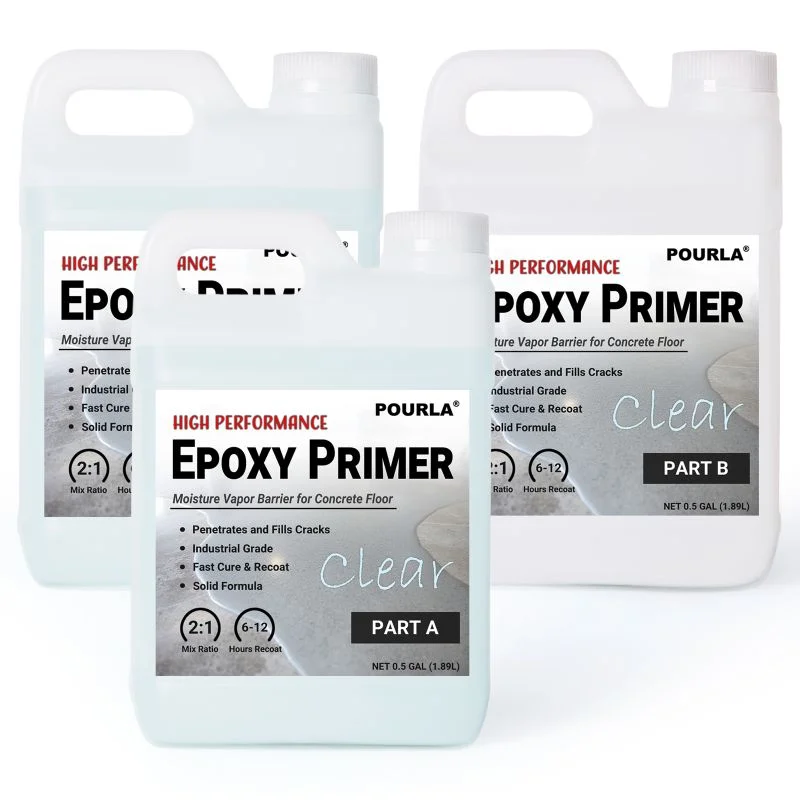
Moisture Seal Primer
150-200 sq.ft/gal coverage. Penetrates deeply to create a vapor barrier.
View Primer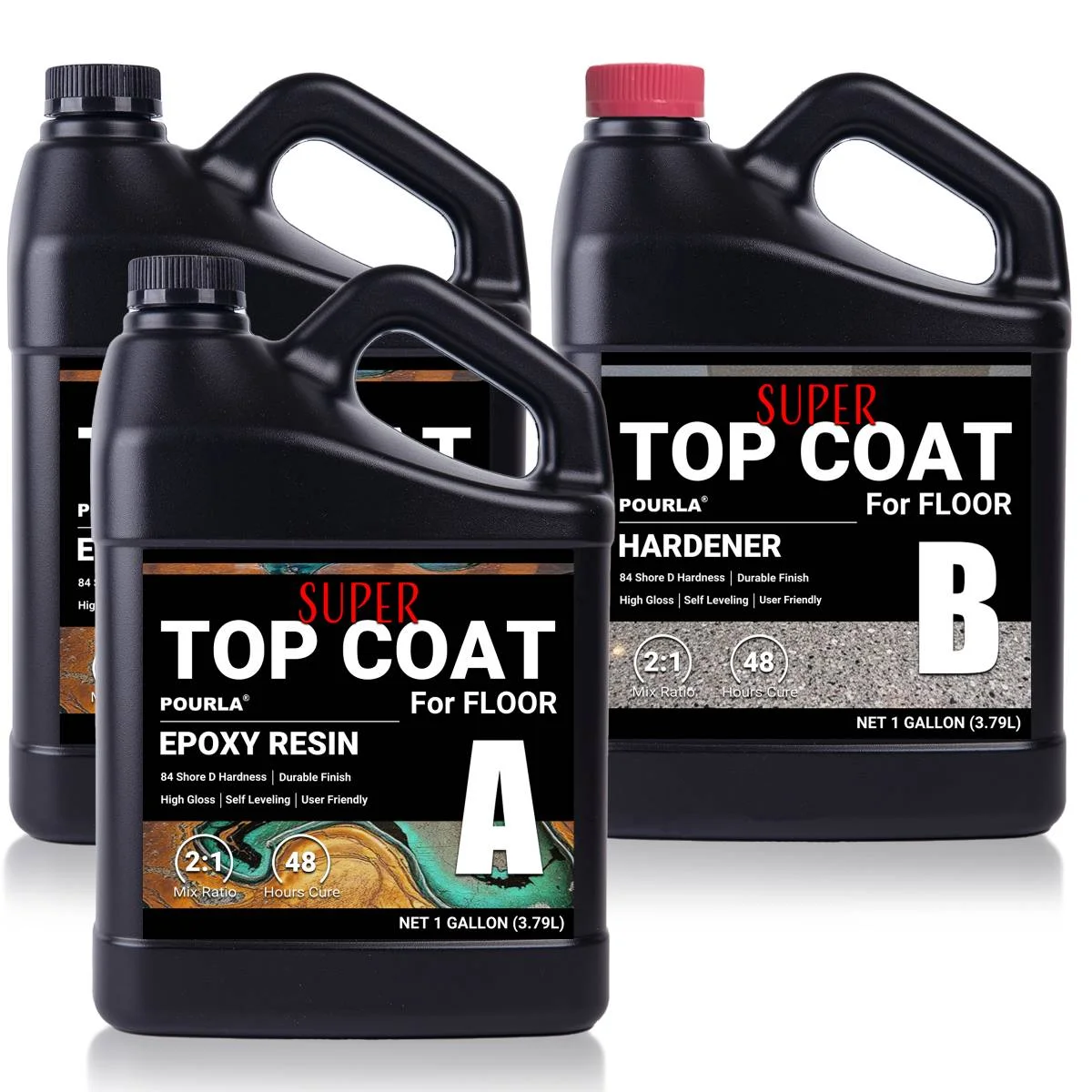
Epoxy Base Coat
100-120 sq.ft/gal coverage. High-build colored base perfect for broadcasting flakes.
View Base Coat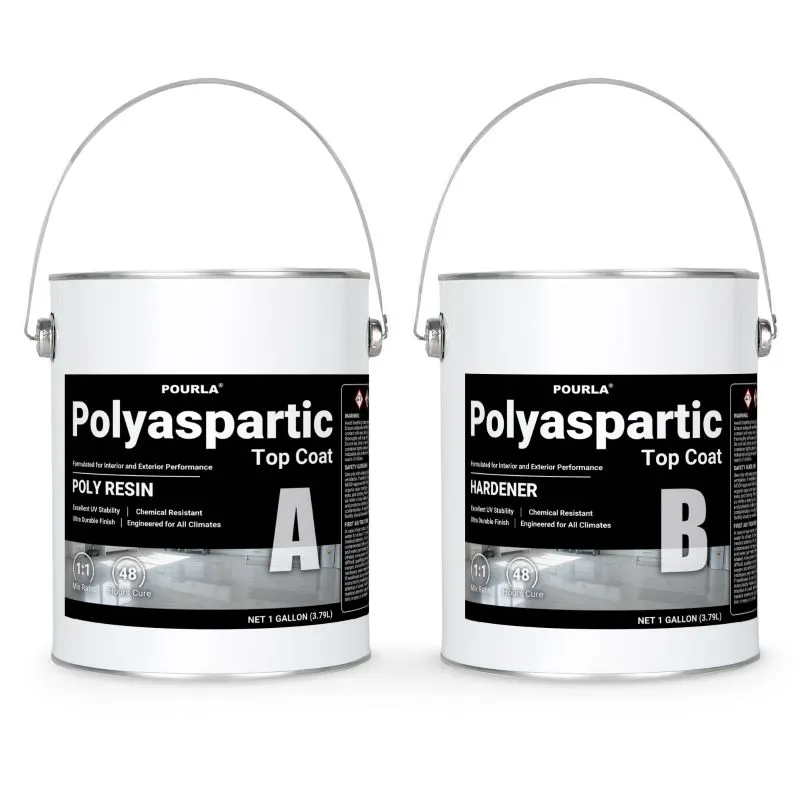
UltraShield Polyaspartic
120-180 sq.ft/gal coverage over flakes. Ultimate UV-stable clear armor.
View TopcoatFrequently Asked Questions
Does the type of concrete affect epoxy coverage?
Absolutely. Older, highly porous concrete or heavily shot-blasted concrete will absorb a significant amount of your primer coat. You will almost always need 5% to 15% more material than the theoretical coverage rate on rough slabs.
Should I measure my floor coatings by weight or volume?
You must strictly follow the product's TDS. For example, Pourla Epoxy Base Coat is mixed 2:1 by Volume, while the Moisture Seal Primer and Polyaspartic Topcoat are mixed by Weight. Do not mix and match these methods, as the resin and hardener have completely different densities.
What happens if I try to stretch the epoxy too thin?
If you spread a high-build epoxy base coat thinner than its recommended 100-120 sq.ft/gal rate, you risk poor adhesion, reduced impact durability, and surface defects like pinholes or a "fish-eye" appearance.
Stop doing the math yourself.
Select the correct calculator below, enter your square footage, and let our tools instantly calculate the exact number of kits you need to order.